
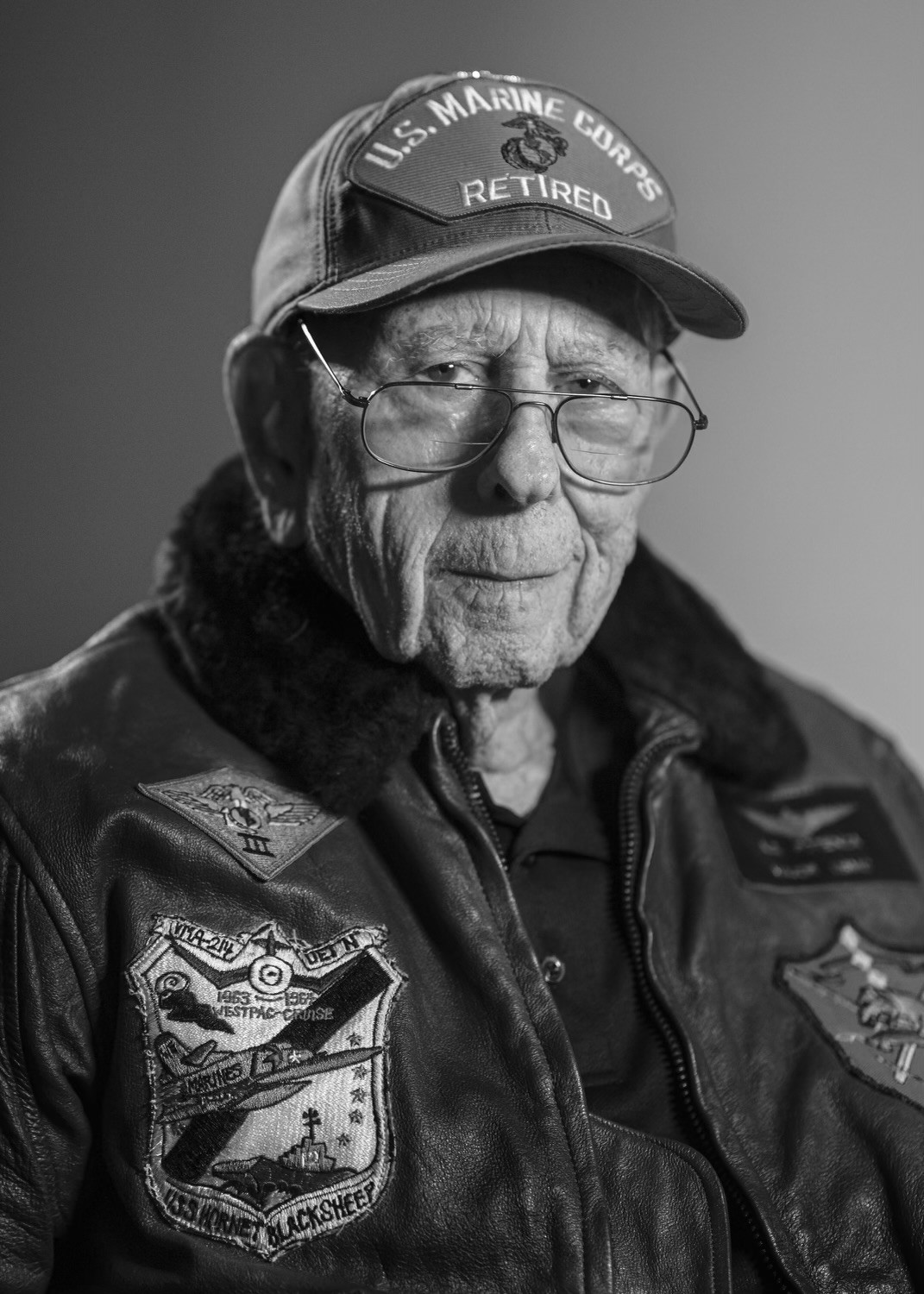
Major Alphonse G. Potenza, USMC (Ret.)
Alphonse Potenza was born in Franklin, Massachusetts, on July 14, 1929, the third child and only son of first‑generation Italian immigrants. He grew up bookended by sisters—two older, Florence and Dorothy, and one younger, Marie—with a father who worked as a mill foreman and a homemaker mother who was singing, always singing, as she cooked, filling the house with whatever popular songs were playing on the radio. That trait was definitely inherited: Dad had a wonderful singing voice, as do his grandsons, Marcus and Parker.
As a little boy, he had a mop of curly blond hair and looked so uncannily like the kidnapped Lindbergh baby that his mother, Carme, was afraid to let him out of the house in case someone called the police. It was the sort of family story he told with a wide smile: the boy who looked stolen, but never once felt anything except embraced and loved by his large Italian‑American family.
Family meant noise and food and bodies everywhere. Dozens of aunts, uncles, grandparents, and cousins at gatherings filling cozy rooms and backyards. The men smoking their smelly stogies, the women with their gentle gossip, the children never still, always running and playing.
The house was Italian in its rhythms and its recipes—spaghetti (Mom always said he liked her spaghetti better than his mother’s), lasagna, a wine press in the basement during Prohibition, trips to the Jersey Shore in the summer. But, growing up, Al insisted he didn’t need to learn Italian. He wasn’t Italian, he’d say. He was American. He was so proud of his country.
The Great Depression hit and money was tight, but they got through on his father’s two–three days a week at the mill, a large garden, and a backyard chicken coop. Al loved to tell how they got those chickens. Their house stood near a hatchery that shipped boxes of fuzzy yellow chicks all over the region. Any chick that wasn’t perfectly yellow and fluffy was simply thrown away. His job, when the family needed more birds, was to bring home the “rejects”—tiny chirping scraps with unacceptable black patches of down, but otherwise perfectly healthy. In his telling, it was just the sensible thing to do and a great way for a young boy to help his family.
He had a dog as a kid, a scrappy Boston Terrier named Terry, and he loved that dog with the fierce, uncomplicated love only a boy can give. Terry went everywhere with him—smart, brave, all heart—and the stories of that dog sank so deep that his daughters, years later, chose Boston Terriers of their own: Ajax and Daphne for Paula, and Zeus for Carol. Terry was, in a way, the starting point of a mini family tradition.
In their Roman Catholic household, Carme dreamed that her only son would become a priest. She prayed for him and wanted him set apart for the Church. But Alphonse had other ideas. During World War II, when he was a young teenager, he watched soldiers on leave in their uniforms walk through town—especially the Marines—and he was awestruck by the way people treated them, the respect and gratitude poured over those young men. The uniforms, their bearing, their sense of purpose: it lit a fire in him.
He already loved his country, and now he knew how he wanted to serve it. At sixteen, he signed up for the United States Marine Corps. His mother didn’t find out until two uniformed men appeared at the front door to ask about her son’s character—a visit she had not exactly been praying for. That moment, too, became one of his favorite stories: the boy who had once looked like a kidnapped baby (his hair had turned black by then—still curly, though), now standing straight‑backed while the Marines came calling.
After he graduated from high school, Al completed a short stint as an enlisted man. The first day he stood at attention in the heat and humidity of Parris Island, South Carolina, he knew immediately that the enlisted life was not for him. He would become a Marine officer. He finished his enlistment, then attended college at St. Michael’s in Vermont, completed his degree, and returned to the Marine Corps and Officer Candidate School because he not only wanted to become an officer, he wanted to be a Marine Corps aviator.
His dream was finally fulfilled when he was assigned jets and became a fighter pilot. He loved flying.
After getting his wings, Captain Al Potenza, USMC, was stationed in Pensacola, Florida, where he taught at the Naval Aviation School, training both Navy and Marine pilots. Then one night in 1960, he attended a party. Sitting quietly in a booth, striking and statuesque, was Mary Faye Davis, one of the hostesses. While he never quite admitted to love at first sight, it was mighty close. Al and Faye were married nine months later at the Pensacola Naval Air Station chapel in May of 1961.
Duty—and the Vietnam War—called. He and his wife were stationed in Hawai‘i, where two of his three daughters were born, and where he traveled overseas for a tour of duty on the USS Hornet aircraft carrier, flying the A-4 Skyhawk and intercepting Russian Badgers and Bears. His handwritten flight books show a grueling schedule. They don’t show the day he came in for a perfect landing, the carrier pitched, crushed the landing gear, and sent the airplane caroming toward the deck’s edge.
It was also on this deployment that Mom gave birth in Hawai‘i to his second child. Dad was out on a mission and missed the phone call with the news. When he got back, he eagerly asked whether it was a boy or a girl, and one of the other pilots teased him and told him to guess. The rumor is Dad punched him in the jaw and knocked him to the deck. Still laughing and rubbing his chin, the guy finally told him he had a daughter—Paula.
Ultimately, he had three overseas tours as a Marine and was stationed at the Pentagon in Washington, D.C., in between the final two.
His last station was the Third Marine Aircraft Wing at El Toro, California—where Al’s third daughter, Alison, was born—and where he flew F-4 Phantom jets, his absolute favorite airplane. He retired at the rank of Major in 1974 with over twenty‑six years in the Marine Corps, and lived in Tustin, California, ever since, and where he discovered travel in a conversion van. Man, did he love his vans. Not that he hadn’t traveled before that. Dad had two weeks off in the summer and drove his family all over the United States using those AAA Trip Tik maps and a tri-level camper he’d throw up on his 1965 Chevy pickup.
Al was married to Faye for fifty‑six and a half years before her passing. To commemorate their life together, at the age of eighty-nine, he drove a final trip from Tustin back to Pensacola. Al visited the chapel where they were married.
He was pretty amazing—opinionated, stubborn, and generous to a fault. He loved life, and he loved his family. It’s hard to believe he’s gone from our lives except for photographs and memories.
Al joins his mother and father, Salvator and Carme; his sisters, Florence and Dorothy; his wife Faye, and his daughter, Paula. He is survived by his daughter Carol, and husband, Leos Flores; his grandson, Marcus Flores and wife, Gaby Garzón-Flores, and great‑grandsons Rafael and Miguel; his granddaughter, Laura Flores, and her husband, Jeremy Payne, and soon‑to‑be‑born great‑granddaughter; his daughter Alison, and her son, Parker Potenza.
Major Alphonse Gerald Potenza, USMC, is the true definition of “Marine,” because once a Marine, always a Marine.
Semper Fi.
Services
Funeral Service : Sunday, July 19, 2026 10:00 am - 1:00 pm
Room: Chapel
Saddleback Chapel Mortuary
220 East Main Street
Tustin, California 92780
Add to My Calendar
America/Los_Angeles
2026-07-19 10:00:00
2026-07-19 01:00:00
AlphonsePotenzaFuneral Service
Funeral Service
220 East Main Street,Tustin, California 92780

View current weather.
Memories Timeline
Guestbook
Sign the Guestbook, Light a Candle





Fly high Al…..